
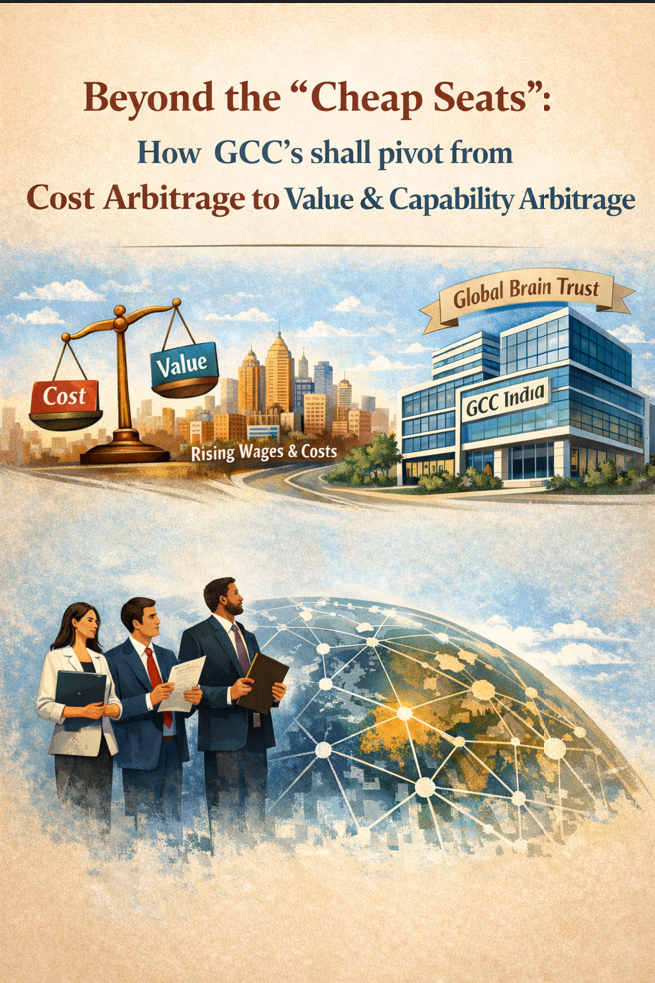
Establishing a Global Capability Center (GCC) in India was once a simple math:
Labor Costs US/EU – Labor Costs India = Success.
But in last 1+ year, this math has changed. With wage inflation in Global Capability Center hitting 9.5% (surpassing the national average) and real estate costs in major Global Capability Center hubs like Delhi, Bengaluru, Pune and Hyderabad climbing, the “Cost Arbitrage” model is eroding. If India Global Capability Center are still selling their India center to HQ based on “cheap seats,” you’re fighting a losing battle.
As we navigate 2026, the question for every Global Capability Center in India is: “If we aren’t the cheapest, are we the best?”
Here is the four-pillar strategy GCCs shall be using to stay indispensable while costs rise:
1. The Hub-and-Spoke Geo-Strategy
Hubs like Delhi, Pune, Bengaluru and Hyderabad are talent-rich but cost-heavy.
The Move: Establish “Spoke” centers in Tier-2 and Tier-3 cities such as Indore, Jaipur, Coimbatore, Kochi, or Ahmedabad.
The Math: These cities offer 20–30% lower operating costs and significantly lower attrition. By 2026, over 40% of new Global Capability Center hiring is expected to be happening outside the “Big 4” Hubs.
2. From Transactional to Product Ownership
You cannot justify a $70-$100K salary for a back-office support role, but you can for a Product Owner who manages a global P&L.
The Pivot: Move up the value chain. Shift from “executing tasks” to “owning the lifecycle.”
Outcome: When the India center owns Global AI Roadmap or End-to-End Cyber Governance, HQ stops looking at the “cost per head” and starts looking at “value & capability arbitrage.”
3. Deploying Agentic AI to Flatten the Pyramid
The traditional 1:5 manager-to-associate pyramid is being disrupted by automation.
The Tech: Use Agentic AI and RPA to handle L1/L2 tasks in Finance, HR, and IT.
The Goal: Various Analyst reports show that AI-led automation can reduce operating costs by 20–40% in the first year. This allows you to hire fewer, higher-skilled “Multiplier” talents who deliver more impact.
4. Adopting Smart Cost Frameworks
Cost optimization in 2026 isn’t about cutting coffee budgets; it’s about structural efficiency.
Contractual Agility: Move toward a model where 1 in 4 roles is contractual. This provides the agility to scale down or pivot without the “drag” of permanent overheads.
Managed Workspaces: Shift from heavy CAPEX (owned offices) to zero-CAPEX managed workspaces to maintain flexibility in a hybrid world.
The Common Thread
Four pillars. One shift: from competing on price to competing on capability.
The geo-strategy lowers cost without lowering ambition. Product ownership moves the center from executing work to owning outcomes. Agentic AI flattens the pyramid so fewer, sharper people deliver more. Smart cost frameworks keep the whole model flexible.
None of these work in isolation. They compound.
A GCC that adopts one is optimizing; a GCC that adopts all four is transforming.
The difference? Whether HQ sees a cost line – or a competitive advantage.
💡 The Bottom Line
The “India Advantage” in 2026 and beyond is no longer about affordability – it’s about capability density. The GCCs that win will be those that stop acting like “back offices” and start acting like “Global Brain Trusts.”
While some of the existing GCC’s have already adopted these 4 pillars, others are still mulling the way forward.
Global CEOs are patient – until the board asks:
“What is our GCC in India delivering that a managed service or AI agent can’t do better or cheaper?”
That’s the moment SLA scores stop mattering.
Cost arbitrage is no longer a strategy. Global Capability Centers that compete only on low-cost delivery risk being replaced.
The pivot isn’t optional. Lead it – or react to it.
#GCC · #GlobalCapabilityCenters · #India · #CHRO · #BusinessStrategy #RKJOnLeadership
1 thought on “Beyond the “Cheap Seats”: How GCC’s must pivot from Cost Arbitrage to Value & Capability Arbitrage”