
How to safeguard your AI Investment?
A global leadership team was celebrating the “successful” deployment of a multi-million dollar AI-native automation solution. On paper, the IT department had checked every box: the large language models were integrated, the agentic workflows were live, and the infrastructure was stable.
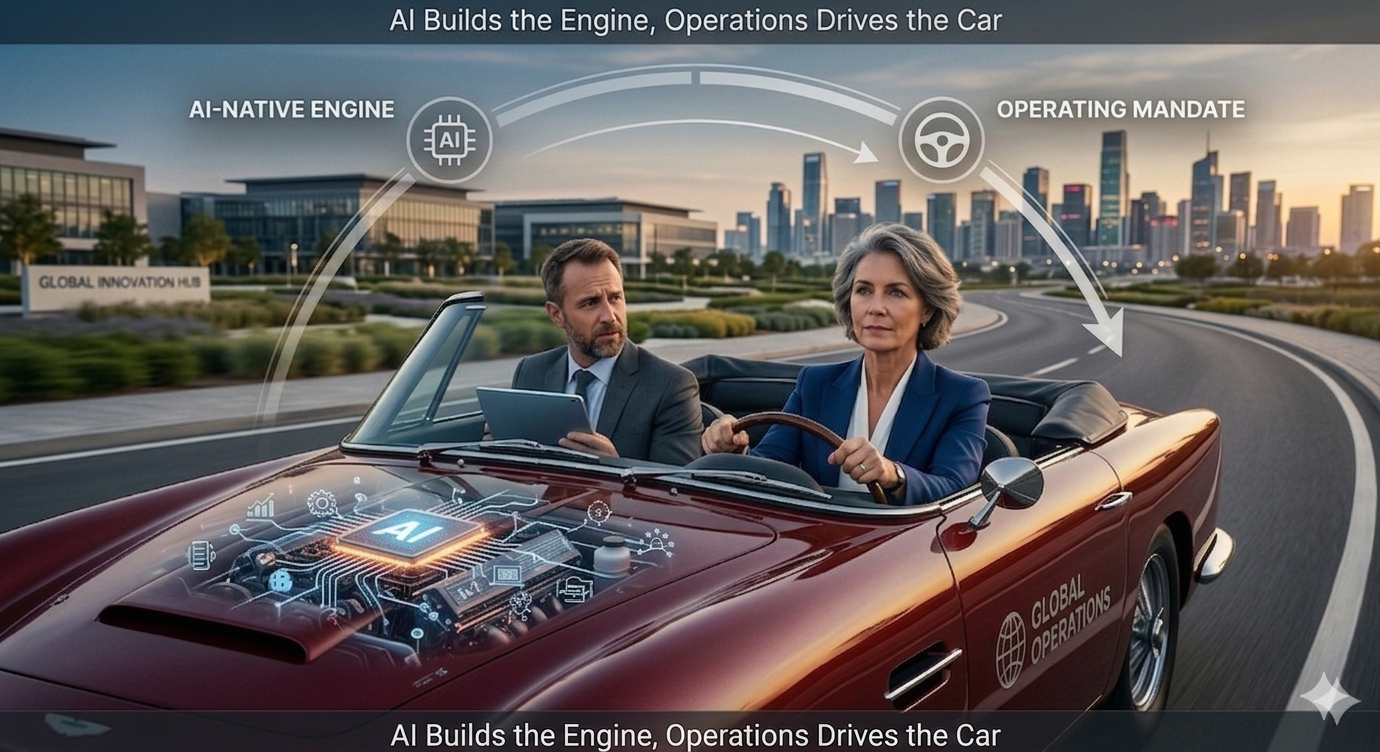
But as they looked at the operational data, the celebration felt premature. Six months later, the cycle times hadn’t budged, and their AI investment unit economics were stagnant. The “efficiency” was a ghost. In other words, IT had successfully built the engine, but nobody was steering the car toward a business outcome.
What went wrong?
The company had fallen into the most common trap in digital transformation: they treated AI investment as a technology project rather than an operating mandate.
The Technician vs. The Architect
It is important to understand that if you hand a broken, 15-step manual legacy process – probably created 25–30 years ago – to advanced AI, you simply get a broken process that moves at the speed of light. You end up “paving the cow path” – layering expensive intelligence over structural inefficiency.
The technical deployment is the easy part. The hard part – the part that moves the P&L – is the architectural redesign of the workflow to leverage what AI investment can do. It requires the authority to tear down legacy silos and the leadership to transition a workforce from “executing the task” to “orchestrating the AI.”
If AI investment stays in the server room, it is a cost center. When it is led from the front office as an operating mandate, it becomes a competitive advantage.
AI investment is Process Re-Engineering (with a Technology Subscript)
Real ROI doesn’t come from the Large Language Model. It comes from the Model Redesign.
This requires leadership with operating authority – typically the CEO, the COO, or a CIO with explicit P&L remit. A traditional IT function rarely has the mandate to walk into the Supply Chain war room or the Finance suite and declare their current workflow obsolete. They are there to support the business, not dismantle it. Only operating leadership has the architectural authority to tear down a legacy system before the first prompt is ever written.
Deploying AI without operational redesign is just an expensive, high-speed way to stay the same. You aren’t transforming. You’re subsidizing inefficiency with high-compute power.
The Era of “Digital Coworkers”
The final, and perhaps most critical, reason operating leadership must lead is Change Management.
IT installs agents. Operations lead people.
When an AI agent absorbs a meaningful portion of a team’s cognitive workload, the IT function’s job is technically done – the stack is live. But for operations leadership, the job is just beginning. How do you reskill those humans to become AI orchestrators? How do you redefine KPIs when the output is now a collaboration between person and machine? How do you shift the culture from “performing” to “auditing and refining” the work?
If the people on the ground see AI as foreign intrusion from IT rather than an operating evolution led by their own leaders, they will resist it. And in that battle, the AI algorithms always lose to the culture.
The Pivot
The most successful organizations I have seen don’t view AI-native automation as a tool to be “delivered” by IT. They view it as a core competency of the business itself.
- IT builds the engine. They ensure the models are powerful, secure, and scalable.
- Operations drive the car. They decide the destination, the speed, and the strategic route.
Five years of running AI-led transformation engagements at my current organization has taught me one thing: the deployments that move the P&L start with operations, not IT. Every cow-path AI investment I have seen begins the same way — with the operating function accepting a workflow as given, instead of asking whether it should exist at all.
If you want to move the needle on your P&L, stop asking your IT leader for an “AI status update.” Start asking your COO for an operational transformation.
#COO #CIO #OperatingModel #DigitalTransformation #AI #EnterpriseAI #RKJOnLeadership
2 thoughts on “Stop “Paving the Cow Path”: Why Your Multi-Million Dollar AI Investment is Failing”