
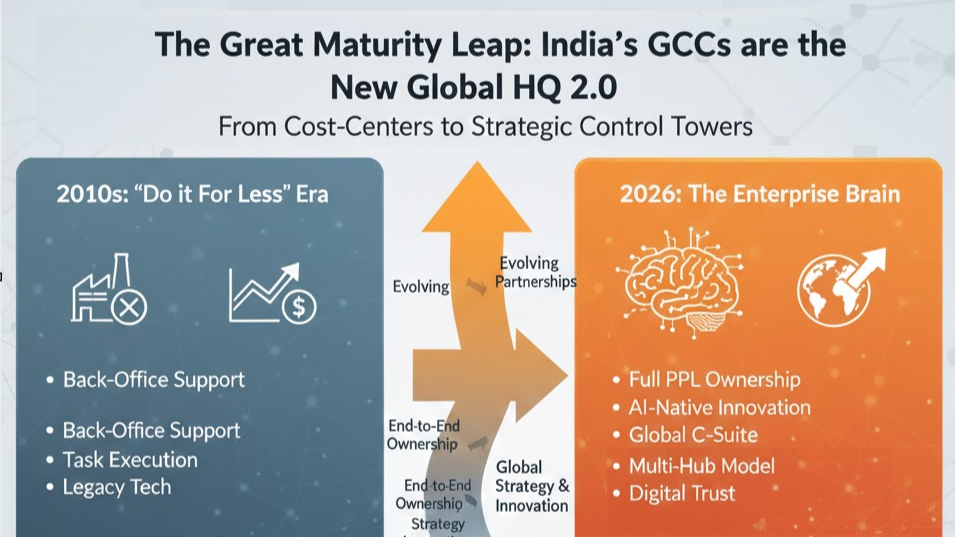
For two decades, the narrative around Indian Indian GCCs was simple: “Do it for less.” But as we move into 2026, the conversation has fundamentally changed. We are no longer talking about back-office support; we are talking about The Enterprise Brain.
Today, India isn’t just the world’s “back office”—it has become the Global Catalyst of the Future.
1. From Cost-Centers to Profit-Engines
The most significant shift in the Indian GCCs landscape is the transition to End-to-End Ownership. Mature centers are no longer just executing tasks passed down from HQ; they own global P&Ls, leading product roadmaps, and managing global functions.
- The Statistics: Owner of “Mega Indian GCCs” (5,000+ employees) in India hit 88, with projections to reach 230 by 2030. These centers are responsible for everything from global compliance to R&D.
2. The Rise of “AI-Native” Operations
Indian GCCs are the primary engine behind the GenAI Revolution. While many global firms struggle with legacy bottlenecks at home, their Indian centers are acting as “sandboxes” for innovation.
- Impact: Whether it’s developing zero-trust cybersecurity architectures or building agentic AI for customer success, Indian GCCs are the ones prototyping the future. Nearly 70% of Indian GCCs are now piloting GenAI use cases that will eventually be rolled out globally.
3. The “Global-Local” Leadership Surge
One of the most exciting trends is the Leadership Alpha. We are seeing a massive surge in “Global Roles” based out of India. We’ve moved past the “Country Manager” era into an era where Global VPs, CTOs, and COOs are stationed in Bengaluru, Hyderabad, and Pune, managing teams in Poland, Mexico, and the US.
4. Beyond the Tier-1 Horizon
While Bengaluru remains the nucleus, the future is multi-hub. The expansion into Tier-2 and Tier-3 cities like Jaipur, Coimbatore, and Visakhapatnam is not just about cost; it’s about tapping into a broader, more stable talent pool. This “Hub and Spoke” model is making the Indian GCC ecosystem more resilient than ever.
5. Sustainability and Digital Trust
The Indian GCCs of 2026 is an Ethical Guardian. With the implementation of India’s DPDP Act and global standards like GDPR, Indian centers are leading the charge in data privacy, green software engineering, and ESG-aligned operations.
The Pattern Behind the Shift in Indian GCCs ecosystem
Looking across these five shifts and one pattern emerges: India’s GCCs are no longer absorbing work – they’re originating it. Ownership, not execution. Innovation, not maintenance. Global mandates, not local support. Each shift on its own is notable; together, they mark a change in kind, not degree. The center that once waited for direction from HQ now sets it. This is what separates a mature GCC from a large one – size measures headcount, but maturity measures influence. The organizations that recognize this early will treat their India center as a source of strategy, not a destination for tasks. The rest will keep managing a cost line.
The Bottom Line for Leaders
As we look toward 2030, the question for global CEOs is no longer “Should we have a center in India?” but “How much of our global strategy can we afford not to run from India?”
The Indian GCCs is no longer a peripheral unit; it is the Strategic Control Tower of the modern multinational corporation.
Most GCCs in India have become “strategic partners” on paper.
The real test is simpler:
What business decision did your GCC make last quarter that HQ didn’t override?
If the answer is “none,” you don’t have a Global HQ 2.0. You have a better-branded back office.
True GCC maturity isn’t measured by titles or slides. It’s measured by decision-making authority.
#GCC · #India · #GlobalBusiness · #FutureOfWork · #CHRO #RKJOnLeadership
(Source of some data & terms – Zinnov, ANSR, TeamLease and probably others)