
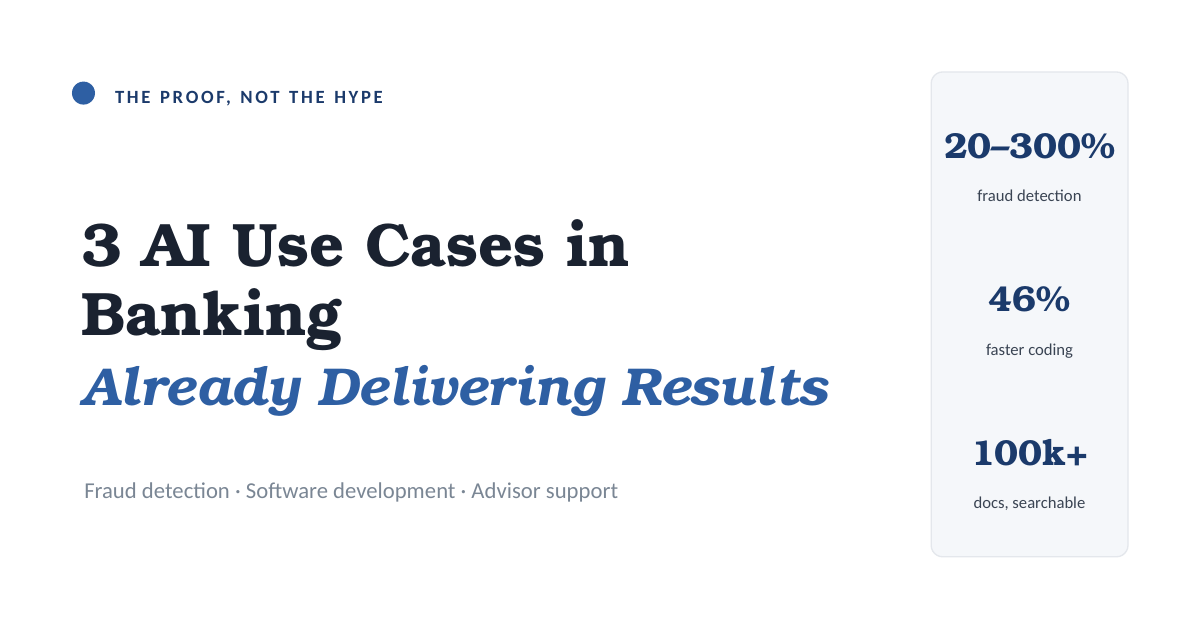
How banks are quietly putting AI to work – from fraud detection and software development to advisor support.
There’s no shortage of conversation around AI use cases in Banking. Walk into almost any industry conference and AI is always on the agenda. Vendors are promising transformation, bold predictions surface constantly, and every few weeks there seems to be another headline suggesting banking is about to be reinvented overnight.
The reality is less dramatic – and far more interesting.
Inside banks, AI is already becoming part of everyday work. Fraud teams are spotting suspicious activity that older systems might have missed. Developers are using AI tools to get through routine coding work faster. Financial advisors who once spent hours searching through research reports and internal documents can now surface relevant information in seconds.
That’s where the more meaningful AI use cases in Banking are emerging – not in futuristic demos, but in practical applications that are already helping people do their jobs better.
For this article, I looked at what banks and financial institutions have shared about their AI deployments. The aim wasn’t to collect predictions about what AI might do someday, but to focus on examples that have already moved beyond the presentation deck and into real operations.
We’ll first take a broader look at AI use cases in banking today, before examining three in detail. They aren’t the only areas with real results, but together they capture how differently AI is being applied across the business.
One caveat is worth keeping in mind from the start. Banking is full of impressive AI statistics, but not all of them should be treated equally. Some figures are company estimates, some come from vendors describing their own products, and others are projections from consulting or research firms rather than audited outcomes.
Where the source of a numbers matters, I’ve made that clear. The figures are still useful, but the bigger claims are better seen as signals of where things are heading, rather than hard proof on their own.
Where Are AI Use Cases in Banking Being Applied Today?
AI use in banking now stretches well beyond innovation teams and pilot projects. It has become part of everyday operations across the business.
Some of the most visible AI use cases in Banking include:
- Fraud detection and payment security – scoring transactions in real time and identifying suspicious patterns that rules-based systems may miss.
- Customer service and virtual assistants – handling routine queries so human agents can focus on complex issues. Wells Fargo’s “Fargo” assistant and Klarna’s shopping assistant are examples.
- Software development – helping engineers write, test and maintain code faster. Goldman Sachs, ANZ and Westpac have experimented in this area.
- Financial advice and research – giving advisors faster access to insights buried across research and internal material.
- Anti-money-laundering and compliance – supporting alert triage and investigations, where repetitive review can consume significant time.
- Contact-Centre intelligence – analyzing calls in real time and providing coaching or guidance to agents.
- Credit-union and mid-market operations – helping smaller institutions such as VyStar improve service and efficiency with leaner teams.
- Finance-team tooling – embedding AI into corporate finance workflows, as companies such as Brex are doing.
- Internal knowledge and productivity – helping employees find policies, processes and research faster, with Deutsche Bank and Morgan Stanley among the examples.
That is a broad landscape. However, this article focuses on three AI use cases in Banking: fraud detection, software development and advisor support.
Fraud Detection: Catching More Fraud Without Frustrating Customers
One of the AI use cases in banking that proves its worth beyond dispute is fraud detection. Banks process enormous volumes of transactions every day, while fraud patterns can shift quickly. AI is well suited to this challenge because it can spot subtle relationships and anomalies that traditional rules-based systems may miss.
Mastercard offers a strong public example. Its Decision Intelligence system helps banks assess transactions at scale, and the company says it supports the safe approval of around 143 billion transactions each year. Its newer generative AI capability, Decision Intelligence Pro, analyses relationships between the entities involved in a transaction to assess risk in under 50 milliseconds.
According to Mastercard, these AI enhancements can improve fraud detection rates by an average of 20%, with gains of up to 300% in some cases.
Reducing False positives is also important but by preventing inconvenience to legitimate customers. Blocking genuine transactions frustrates customers and creates unnecessary friction. Mastercard says its approach cut false positives by more than 85% in its own analysis, potentially improving both security and customer experience.
These numbers should still be treated with some caution, as they are Mastercard’s own reported results for a product it sells.
Even so, fraud detection remains one of the most established AI use cases in Banking. It is a high-volume, fast-moving problem where AI’s ability to identify patterns can deliver clear value. JPMorgan has also publicly explored large-language-model techniques to help detect fraud and other risks within its systems.
Software Development: 46% Productivity Gain That Surprised the Skeptics
Software development may not be the most obvious AI use cases in banking, but its impact can be significant. Modern banks rely on software across customer apps, payments, risk systems and internal operations, so improving developer productivity can have a broad effect.
Westpac tested this through a structured experiment with 60 engineers split into four groups. One group coded as usual, while the other three used generative AI tools from Microsoft, Amazon and OpenAI. All teams completed the same seven tasks across different programming languages, including data extraction, unit testing and data transformation.
Westpac reported 46% productivity improvement across the AI-assisted teams, with no decline in code quality. The bank assessed vulnerabilities, maintainability and reliability, while the hand-coding group took around three and a half times longer on average. The benefits also differed by experience level. Westpac said 83% of junior developers were “blown away” by the tools, which gave them an always-available source of guidance. Senior engineers valued AI for handling repetitive work and freeing up time for more complex problems.
This is a more realistic picture than AI replacing developers. Instead, it reduces routine effort and helps engineers focus on work that requires experience and judgment. Among AI use cases in Banking, developer productivity is also spreading quickly. Goldman Sachs has experimented with ChatGPT-style coding tools, while ANZ has tested GitHub Copilot.
The advisor’s assistant: making 100,000-document library usable
The third AI use cases in Banking is less about automation and more about access to knowledge. Large banks already hold vast research libraries, policy documents and internal guidance. The real challenge is finding the right information quickly enough to be useful.
Morgan Stanley provides a clear example. It’s “AI @ Morgan Stanley Assistant” built using OpenAI’s GPT-4, gives financial advisors and support staff conversational access to more than 100,000 research reports and internal documents. Instead of searching through archives or multiple systems, advisors can ask questions about markets, internal procedures or client-related issues and get relevant information much faster
The goal is not to replace advisor judgment, but to reduce time spent searching, summarizing and handling routine work. Morgan Stanley’s co-president said the tool was intended to create efficiencies and “free up time to do what you do best: serve your clients.”
The firm also tested Debrief, a tool that summarizes client meetings and drafts follow-up emails, extending AI’s value beyond research into post-meeting administration.
This type of document-grounded assistant is now one of the most discussed AI use cases in Banking. Deutsche Bank is moving in a similar direction, and many large banks are developing their own internal knowledge tools.
There are also some large financial estimates attached to this trend. JPMorgan has projected around $1.5 billion in realized AI value for 2023, while McKinsey has estimated that generative AI could add up to $1 trillion annually to global banking. Both figures are useful context, but they remain projections rather than directly comparable measured outcomes.
What Do These AI Use Cases in Banking Really Add Up To?
Once the hype is stripped away, a practical pattern emerges. The strongest AI use cases in Banking tend to solve problems that are high-volume, repetitive, or difficult to manage with rules alone.
Fraud detection fits because suspicious patterns can shift too quickly for traditional systems to catch. AI-assisted coding works because much of software development involves repetitive groundwork around a smaller number of complex decisions. Knowledge assistants help because banks already have vast amounts of information; the challenge is finding the right piece quickly.
Across these AI use cases in Banking, the most useful framing is not “AI replaces people.” It is that AI removes friction, giving employees more time for work that depends on judgment, context, and experience.
What I take away from these examples is that AI in banking delivers the clearest value where the scale is high, mistakes are costly, and the technology can work within tightly controlled workflows
There are still important caveats. Large language models can hallucinate or produce misleading answers, which is why banks such as Morgan Stanley use controlled enterprise environments. Westpac has also explored finance-specific models rather than relying only on general-purpose systems trained on public internet data.
Regulation, data privacy, and model risk remain unresolved concerns. Many headline statistics in banking AI are self-reported or projected, so they should be treated with caution.
Despite these concerns around accuracy, governance, privacy, and model risk, the examples above show that AI has already moved beyond experimentation in several areas of banking and into day-to-day operations.
That may be less dramatic than the industry hype, but it is also more credible.
Sources
Sources referenced include Mastercard’s newsroom, iTnews reporting on Westpac’s coding experiment, and Forbes’ coverage of Morgan Stanley’s AI assistant. Company claims, projections, and forecasts should be checked against primary and independent sources before being relied upon